


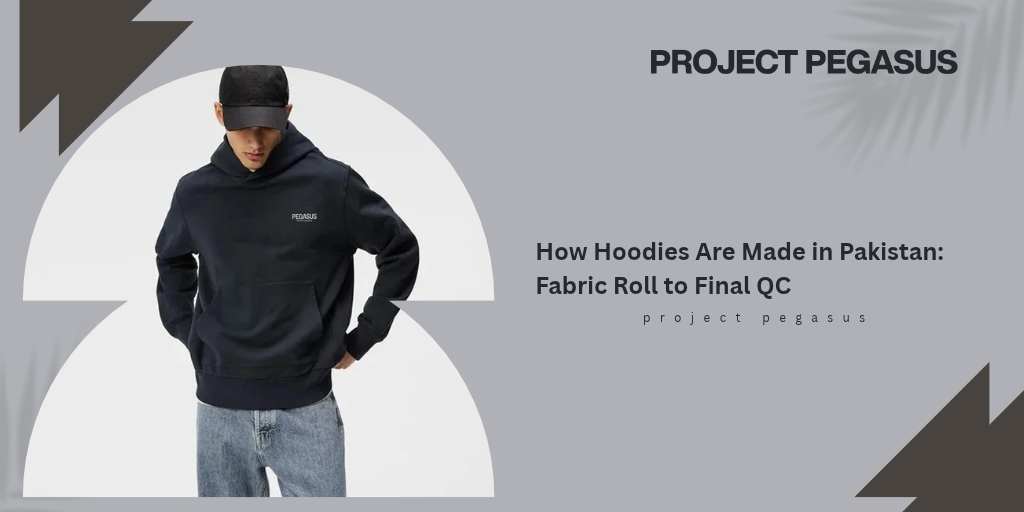
How Hoodies Are Made in Pakistan: Fabric Roll to Final QC
You see a hoodie online and wonder why one costs Rs. 4,000 and another Rs. 10,000. Most of the answer sits in steps you never see: how the fabric was knitted, how it was cut, how the seams were sewn and how it was checked before packing.
Direct answer: Most hoodies made in Pakistan follow the same sequence: knit fleece fabric is produced and dyed, relaxed to reduce shrinkage, cut from graded patterns, decorated with print or embroidery, sewn on overlock and flatlock machines, then finished and inspected. Exact steps and quality vary by factory, so the useful skill is knowing which stages affect fit, durability and feel.
A note on how this guide was written. It is published by Project Pegasus, a Pakistani streetwear brand, so we have a commercial interest in the subject. The process below describes how hoodie production typically works in the industry. It is not a tour of one specific factory. Where we refer to our own products, we only use details listed on our own pages.
The short version: seven stages
| Stage | What happens | What it changes for the wearer |
|---|---|---|
| 1. Fabric knitting | Cotton or blended yarn is knitted into fleece or terry | Weight, warmth, softness inside |
| 2. Dyeing and relaxing | Fabric is dyed, then finished to settle the knit | Colour depth, shrinkage after washing |
| 3. Pattern and grading | Pieces are drawn and sized from S to XL and beyond | Fit, shoulder drop, length |
| 4. Cutting | Layers are spread and cut by marker | Panel match, shade consistency |
| 5. Decoration | Print or embroidery is applied | Look, feel, wash life of the graphic |
| 6. Sewing | Panels, hood, pocket, rib and hems are joined | Seam strength, how the hoodie ages |
| 7. Finishing and QC | Threads trimmed, garment pressed, measured and inspected | Whether what you receive matches what you saw |
Stage 1: Fabric starts as yarn, and GSM tells you what it will feel like
A hoodie begins as yarn, usually cotton or a cotton and polyester blend. Knitting machines turn it into fleece, which has a smooth face and a brushed, soft back. French terry is the lighter cousin, with small loops left on the inside.
GSM means grams per square metre. It measures fabric weight, so a higher number generally means thicker, warmer cloth. It does not measure quality by itself. Two fabrics at the same GSM can feel very different depending on yarn quality, knit construction and finishing.
For context, our own pages list the Cozy Cropped Hoodie as 450 GSM heavyweight and the Heritage Premium Sweatshirt as 350 GSM cotton fleece. That is the manufacturer listing from Project Pegasus, not an independent lab result.
Stage 2: Dyeing and relaxing decide how a hoodie behaves after wash one
Fabric is usually dyed before it is cut, either as a finished roll or from dyed yarn. After dyeing, good mills relax or compact the fabric so it holds its size. This step matters more than most shoppers realise. Fabric that skips it can shrink noticeably the first time you wash it at home.
Rolls can also differ slightly in shade from one dye lot to another. Careful factories keep panels from a single hoodie within the same lot so the sleeves and body match.
Stage 3: Pattern making is where fit is decided
Before anything is cut, a patternmaker draws each piece: front, back, sleeves, hood, pocket, rib trims. A base pattern is then graded, which means scaled up and down into each size while keeping proportions sensible.
This is where silhouette gets built in. A dropped shoulder moves the seam below the natural shoulder line for a relaxed look. A cropped body ends at the waistband. If a pattern is poorly graded, the medium may fit well while the XL looks stretched in the wrong places.
You can test this yourself. Lay a hoodie you already like flat, measure chest width, length and sleeve length in inches, and compare with the garment measurements on the product page. Our product pages list measurements for this reason.
Stage 4: Cutting is quieter than it looks, but it shows up in the final garment
Fabric is spread in layers on a long table, a marker (a map of how pieces nest together) is laid over it, and the stack is cut. Straight grain matters. If panels are cut off-grain, side seams can twist after washing.
Cutting is also where fabric waste is controlled. Tight marker planning saves material, which is one of the real cost levers in hoodie production.
Stage 5: Print and embroidery can be added before or after sewing
Graphics are commonly applied to cut panels, which is easier to keep straight, or to the finished garment, which suits some placements. The usual methods are:
- Screen print: ink pushed through a mesh stencil. Durable when cured properly, and common for bold graphics.
- Puff or raised print: a layer that expands with heat for a textured look.
- Embroidery: thread stitched into the fabric. Stitch density affects feel. Very dense embroidery on soft fleece can feel stiff.
- Digital printing: suits detailed artwork, though feel and wash life depend heavily on the process.
Our own care advice is simple and applies broadly: wash inside out in cold water, avoid high dryer heat, and air-dry graphic prints.
Stage 6: Sewing is where you can judge construction fastest
Hoodies are typically assembled on industrial machines. The names you will see mentioned:
- Overlock: trims and wraps the raw edge while joining panels, which stops fraying.
- Flatlock or coverstitch: a flat seam, often at hems and cuffs, comfortable against skin.
- Bartack: a small, dense reinforcement at stress points such as pocket corners.
- Rib knit: the stretchy trim at cuffs and waistband that helps the hoodie keep its shape.
The hood, pocket and drawcord eyelets are the details that fail first on weak products. A hood with a single thin layer will flop, and a hood lined with matching fabric holds shape better. These are observations from general industry practice, not a test of any specific product.
Stage 7: Finishing and QC separate a good batch from a lucky one
After sewing, loose threads are trimmed, stains are spot cleaned, garments are pressed and tags are attached. Then comes inspection. A solid quality control process usually works at three points:
- Inline checks while sewing, to catch problems early.
- End-of-line checks on finished pieces.
- Final inspection by sampling from the packed batch, often using a statistical sampling method such as AQL, where a set number of units is pulled and checked against an agreed defect limit.
Typical checks include measurements against a tolerance, shade match, print placement, seam strength, stray marks and a wash test on sample pieces for shrinkage and colour bleeding.
Because ready-to-wear is checked by sampling, a QC pass reduces defects but does not guarantee zero. That is why a clear exchange policy matters. Our current offer is 10-day exchanges and returns, so check the refund policy for conditions before ordering.
Why this matters in Pakistan specifically
Winters vary a lot across the country. Islamabad, upper Punjab and the hills get properly cold from December to February, while Karachi stays mild. That changes what you should buy.
- Choose 350 to 450 GSM fleece if you want warmth as a base layer in the northern winter months.
- Choose a lighter weight if you are dressing for October, November or March, or living somewhere warmer.
- Choose a cropped cut if you wear high-waist trousers or cargos and want the hoodie to sit at the waistband.
- Choose a sweatshirt if you plan to layer under a jacket, since the neckline is cleaner.
If you are comparing options, Project Pegasus hoodies and sweatshirts lists garment measurements in inches on each product page, and the winter collection groups the heavier pieces together.
A buyer checklist you can use on any hoodie
- Is GSM stated? If not, ask.
- Are garment measurements given in inches, not just S, M, L?
- Does the hood have a lining or double layer?
- Are cuffs and waistband rib knit, and do they look dense?
- Are there reinforcements at pocket corners?
- Are care instructions clear, especially for printed pieces?
- Is there an exchange policy, and are the conditions readable?
FAQs
Does higher GSM always mean a better hoodie?
No. GSM tells you weight, not quality. A very heavy hoodie can be too warm for many parts of Pakistan, and yarn quality and finishing still matter.
Why do some hoodies shrink and others do not?
Mostly because of how the fabric was relaxed after knitting and dyeing, plus how you wash and dry it. Cold water and low heat help.
Is a hoodie made in Pakistan lower quality than an imported one?
Origin alone does not tell you. Pakistan has a large textile industry, and quality depends on the specific mill and factory. Judge by fabric details, construction and QC rather than country label.
How can I check the fit before buying online?
Measure a hoodie you already own, lay it flat, and compare chest, length and sleeve to the listed garment measurements.
Can I order from outside Pakistan?
Our collection page says international orders are taken on request through WhatsApp or email. You can reach us through the contact page.
Conclusion
Learn the seven stages and you can read a hoodie like a specialist: look at weight, check how the fit was drafted, inspect the seams and ask how it was tested. If you want to put that into practice, browse the full range at Project Pegasus and compare measurements against your own favourite hoodie before you choose.
Ready to Find Your Next Hoodie?
Now that you know what goes into a well-made hoodie, put it to use. Browse the full range of Project Pegasus hoodies and sweatshirts and compare the garment measurements in inches against a hoodie you already own. If you are shopping for the colder months, the winter collection brings the heavier pieces together, and our best sellers are a good place to start if you want to see what other customers pick. Have a question about fit, fabric or delivery? Contact the Project Pegasus team and we will help you choose. Tell us your usual size and we will point you to the right piece. You can also read the shipping policy and refund policy before you order. Visit Project Pegasus today.
Leave a comment
All comments are moderated before being published.
This site is protected by hCaptcha and the hCaptcha Privacy Policy and Terms of Service apply.